
Key takeaways
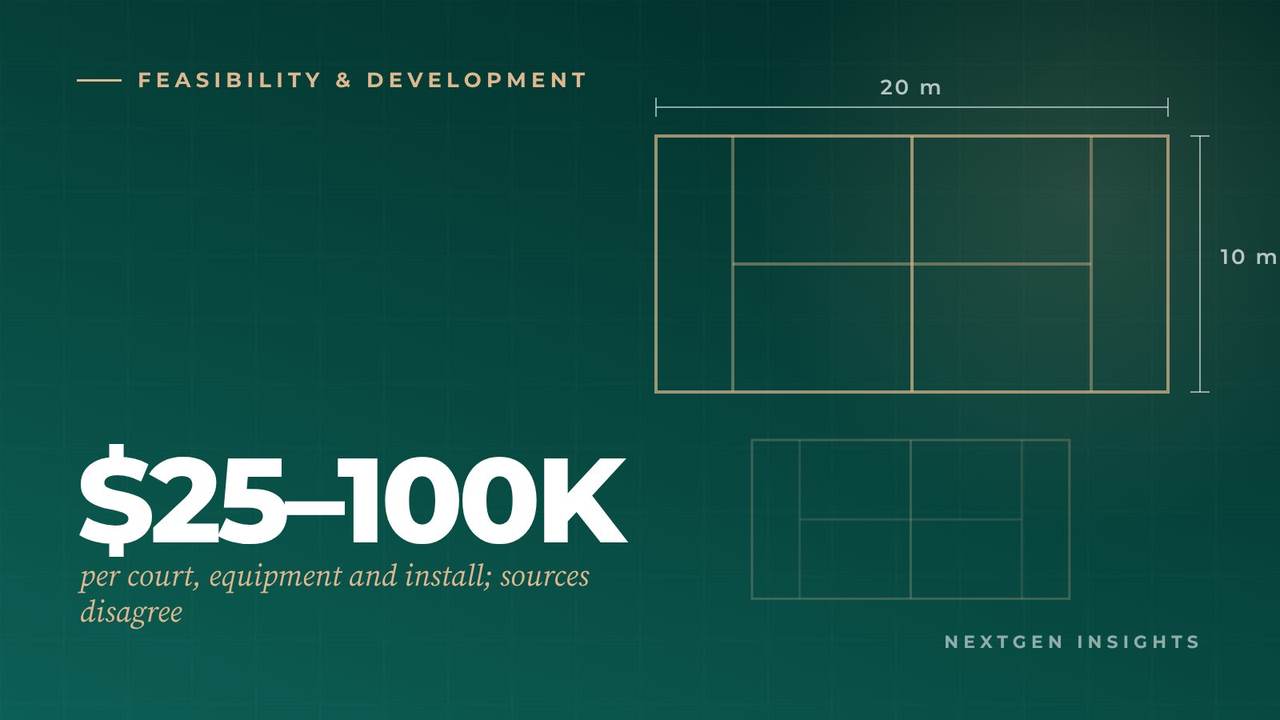
- Published per-court estimates for the U.S. range from roughly $25,000 to $100,000 for equipment and installation, and indoor courts that include a building can exceed that. Sources disagree, which is itself the lesson: get firm quotes early.
- The court is the visible cost. Site work, the building shell, electrical service, permits, clubhouse fit-out, pre-opening costs and working capital often decide whether the project fits its budget.
- Per-court cost falls as the court count rises, because grading, mobilization and crews are shared across courts.
- Build the budget bottom-up with a contingency, and separate what you spend before opening from what you fund while the club ramps up.
“How much does a padel court cost?” is the first question most prospective owners ask, and the answer on the internet is a number that looks precise and is not. The honest answer is a range that depends on the format (outdoor, covered or indoor), the site and the quality of the specification. This article lays out what published sources say, why they differ and how to build a budget you can defend to a lender.
What the sources say about the court itself
We reviewed two public cost guides, both from companies with a commercial interest in the category. Their ranges overlap but do not agree.
Sources: Padel Browser (June 2026) for outdoor and indoor; Sports Venue Calculator (2026) for the all-types range. Both are vendor or directory estimates and they overlap only partly, so treat them as orders of magnitude and obtain firm quotes. Excludes land, rent, fit-out of clubhouse areas, pre-opening costs and working capital.
- Padel Browser (June 2026): a single outdoor court at $25,000–$60,000, with a typical mid-range build at $35,000–$45,000, premium builds with full panoramic glass above $100,000, and indoor courts at $70,000–$100,000 or more per court once the building shell, roof, lighting design and ventilation are included.
- Sports Venue Calculator (2026 U.S. estimate): $39,076–$99,920 per court across all types, with larger facilities costing less per court. Its worked examples run at roughly $84,000–$95,000 per court for outdoor projects and $42,000–$46,000 per court for indoor projects installed inside an existing hall, where the building cost is excluded.
The conflict is explained by what is included. A court “package” (structure, glass, mesh, turf and lighting) is one thing; a court installed on a prepared, drained foundation with electrical service is another; a court inside a new building is a third. When you compare quotes, compare scope first and price second.
The cost stack: what goes into a club budget
Treat the budget as seven blocks. The percentages below are our planning heuristics, not published statistics, and they vary widely by site.
| Block | What it covers | Why it varies |
|---|---|---|
| 1. Court systems | Steel structure, tempered glass, mesh, turf, LED lighting, delivery and installation | Glass specification, turf quality, lighting package, import logistics. Courts are typically manufactured in Europe. |
| 2. Site work and foundation | Grading, drainage, slab (asphalt or concrete), utilities | One guide puts ground and foundation at 0–40% of a project: the largest line for a single outdoor court, absent for an indoor court in an existing hall. Padel Browser quotes about $5,000–$8,000 for an asphalt slab and $8,000–$12,000 for concrete per court. |
| 3. Building or enclosure | New hall, tensile or air-supported dome, or conversion of an existing building | Clear height matters. Sports Venue Calculator cites at least 7 meters (about 23 feet) above the playing surface. |
| 4. Electrical, mechanical and life safety | Service upgrades, HVAC or ventilation, fire protection, accessibility | Existing-building condition and local code. |
| 5. Clubhouse and amenities | Reception, changing rooms, lounge, F&B, pro shop, recovery or wellness areas | Concept. This is where a court-only club and a destination club diverge. |
| 6. Soft costs | Design, engineering, permits, legal, insurance, technology, brand | Jurisdiction and complexity. Permitting “can add weeks or months,” as one guide puts it. |
| 7. Pre-opening and working capital | Hiring, marketing, launch events, operating losses during ramp-up, contingency | Time to reach target utilization. |
Timelines and lifespan
Assembly on site is the short part: Padel Browser cites about four to eight weeks after materials arrive and Sports Venue Calculator three to six weeks for the on-site build. Manufacturing and shipping come first and permitting often runs longer than construction. Plan the critical path from approvals, not from the assembly date.
Turf typically needs resurfacing every five to eight years with regular play, at a few thousand dollars per court, and courts are expected to last 20–25 years. Put resurfacing in the operating model as a reserve, not a surprise.
Why bigger is cheaper per court
Both sources observe that per-court cost drops as the number of courts rises. Grading, mobilization, engineering, electrical service and project management are largely fixed, so spreading them across eight courts rather than two lowers the average. The same logic applies to operations: a front desk, manager and cleaning crew serve a four-court club only slightly better than a two-court club, so staffing cost per court falls with scale. The trade-off is that larger clubs need a larger catchment and more capital at risk before the first booking.
From cost to return: the questions to answer
A budget is only meaningful against revenue. Some public sources publish confident payback figures; we treat these cautiously because they are rarely tied to audited operating data. One widely shared “ROI analysis” we reviewed, for example, was inconsistent with its own case-study numbers. Instead, answer these questions for your site:
- At what utilization and average price per hour does the club cover its fixed costs? Playtomic reports about 85% average peak-hour occupancy in the UK’s major clubs and about 41% in Finland’s commercial clubs, a reminder of how wide the range is.
- How long does it take to reach that utilization, and what funds the club until then?
- What is the revenue per court per month at the top and bottom of the market? Playtomic finds top-performing clubs earn about €3,531 per court per month versus €736 for bottom performers, about five times more in the same markets.
- What is the downside case if rent, construction cost or ramp-up time is 20% worse than planned?
How to get a reliable number
- Define the concept first. Number of courts, indoor or outdoor, amenities and F&B level.
- Get three scoped quotes from court suppliers and one from a general contractor with site-specific allowances.
- Commission a site assessment (zoning, utilities, soil and drainage, clear height) before pricing.
- Add contingency and working capital explicitly, as separate lines.
- Test the number against revenue in a conservative, base and optimistic case.
Our free feasibility checklist turns these steps into a worksheet, and our business planning and financial modeling work builds the model for lenders and investors.
Sources
- Padel Browser: How much does it cost to build a padel court? (2026).
- Sports Venue Calculator: Padel court construction cost guide (2026).
- PADEL1969: Global Padel Report 2026 summary (UK and Finland occupancy; top vs. bottom club revenue).
- SportsField: How much does a padel court cost? (scope of what court packages include).
Cost figures are vendor or directory estimates in U.S. dollars, as of mid-2026. They are not quotes.