
Key takeaways
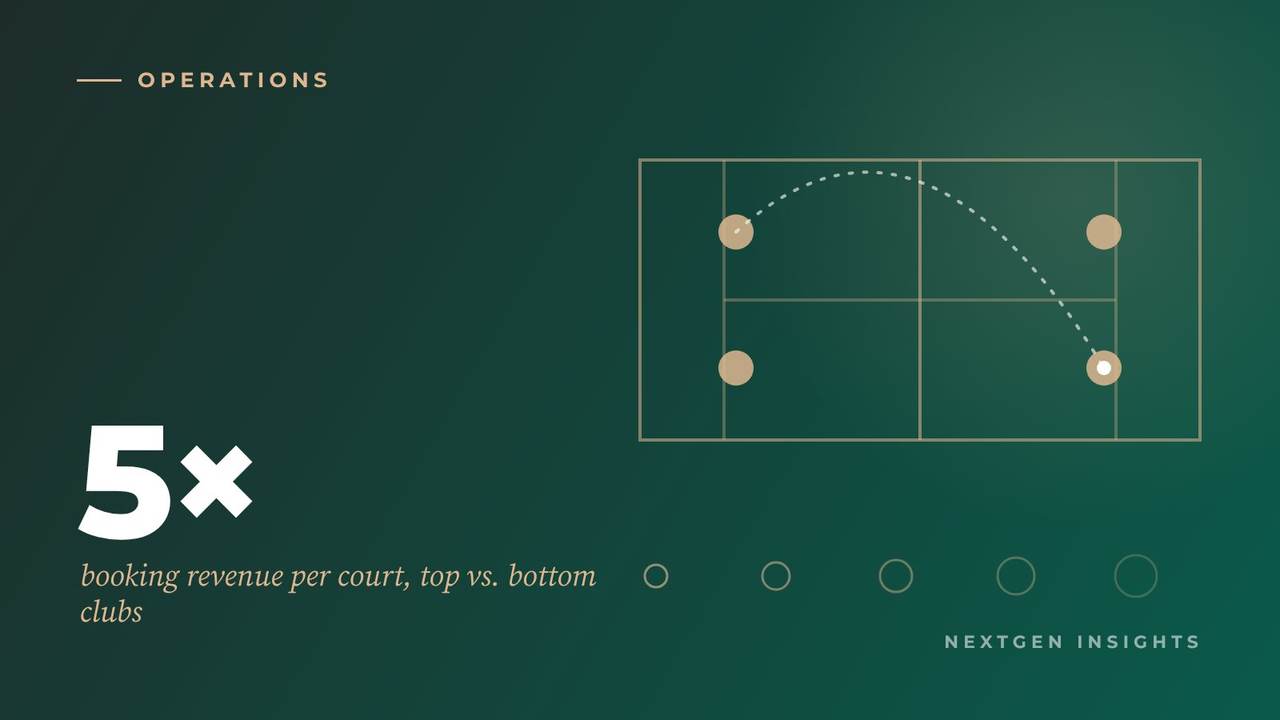
- Within the same markets, top-performing clubs earn about five times more booking revenue per court than bottom performers: €3,531 versus €736 per court per month (Playtomic–Strategy&, 2026).
- Playtomic identifies seven performance drivers, including average price per hour, online booking share, open-match share and academy and competition share. Court count alone is not one of the winners.
- About 90% of top clubs offer services beyond court access. Social events (74%) and instructor-led activities (72%) are the most common; facility and wellness access (56%) is the highest-yield category for clubs that offer it.
- Diversified revenue stabilizes the business, but every extra line adds operating complexity. Add it only when you can run it well.
A padel club sells a scarce, perishable product: court time. An empty court at 2 p.m. on a Tuesday can never be sold again. The best clubs treat court rental as the engine but build the rest of the business around it, with memberships, coaching, leagues, events and hospitality that fill the quiet hours and deepen loyalty. This article describes what the data shows about how leading clubs do it.
The spread between clubs is the story
Playtomic’s 2026 Global Padel Report, produced with PwC’s Strategy& practice, compares top and bottom performers within the same markets. The gap is large.
Source: Playtomic–Strategy& (PwC) Global Padel Report 2026, as summarized by PADEL1969. About 5× within the same markets.
The report lists seven drivers behind the difference: the number of courts per club, games per court per month, average price per hour, the share of bookings made online, the share of indoor courts, the share of open matches and the share of academy and competition play. The implication is that the winners do not simply have better locations. They run better programs, price with discipline and keep their courts full through the week.
Layer 1: court rental, priced and filled intelligently
Court rental is the foundation. Three levers matter most.
- Price architecture. Peak, off-peak, weekend and member prices let you fill quiet hours and capture value at peak. Playtomic reports that the U.S. has the highest average booking price of any market it tracks, about €92 (roughly $100) per booking session, but that average hides large differences by city and club.
- Utilization. Playtomic cites about 85% average peak-hour occupancy for major UK clubs and about 41% peak utilization for commercial clubs in Finland, a mature market past its boom. The point is not to chase a benchmark but to know your own peak and off-peak utilization and what it takes to move them.
- Open matches. Letting players join a match that needs one to three more people fills courts and brings in new customers. It is one of the seven drivers Playtomic tracks.
Layer 2: memberships and recurring revenue
Memberships convert occasional visitors into predictable revenue and a community. Typical structures include unlimited or discounted booking in exchange for a monthly fee, priority access windows, guest passes and member-only events. The design question is how to protect peak-hour capacity: a membership that lets members book every peak slot at a discount can cannibalize your highest-value hours. Many clubs restrict discounted rates to off-peak windows or limit advance booking.
Layer 3: instruction, academies and competition
Coaching has two roles: it is a revenue line and it is how beginners become regulars. Playtomic’s survey of 185 top-performing clubs found that 72% run instructor-led activities such as group coaching, pilates, yoga or fitness classes. For about half of those clubs, instruction contributes under 10% of revenue, so its main value is strategic: it builds skills, loyalty and a pipeline of league and tournament players. Structured academies and competition (leagues, ladders, tournaments) also appear in the report as a performance driver.
Layer 4: social events, hospitality and wellness
The same survey, conducted in March and April 2026 across clubs in Spain, the UK, Germany, the U.S. and Asia-Pacific, found that the most common services beyond court access were:
Source: Playtomic–Strategy& Global Padel Report 2026 survey of 185 top-performing clubs in Spain, the UK, Germany, the U.S. and APAC (March–April 2026). The sample skews to larger, digitalized operators.
- Social events (74% of clubs): corporate events, mixers, round-robins and parties. About 45% of clubs offering them earn 10–25% of income from them.
- Instructor-led activities (72%): often small in revenue terms but important for retention.
- Facility and wellness access (56%): gym, sauna, cold plunge, pool or lockers. This is the highest-yield category: about 38% of clubs offering it earn more than 25% of revenue from it and about 14% earn more than half.
- Extras and add-ons (38%): video recording, ball machines, food and beverage. U.S. clubs show higher add-on adoption than other regions in the data.
The survey notes a sample bias: it covers larger, digitalized, top-quartile operators, so it shows what leaders do rather than what the average club does. Regional patterns also differ: Germany leans toward saunas, Spanish clubs often feature pools, and Asia-Pacific clubs commonly have recovery areas.
Layer 5: sponsorship, retail and partnerships
Retail (rackets, apparel, balls) is a modest but useful line that also supports the brand. The global padel equipment market has been compounding at about 34% a year since 2019, according to Playtomic, with rackets about two-thirds of value. Sponsorships, naming rights and brand partnerships (technology, apparel, beverage, financial and automotive brands) become realistic once a club has a visible community. See our guide to events and sponsorships.
Where clubs go wrong
- Adding amenities before demand. A sauna or restaurant that is under-used is a fixed cost, not a revenue line. Sequence additions after the court business is stable.
- Underpricing peak hours. Discounting at the moment of highest demand gives away margin.
- Treating F&B as an afterthought. Food and beverage works when it is designed into the space, staffed and priced for the audience. Otherwise it drags.
- Not measuring. Revenue per available court hour, member retention and the share of off-peak bookings should be reviewed weekly.
A practical sequence
- Launch with a clear court-rental price architecture and online booking.
- Add open matches, beginner clinics and a first league within the first 90 days.
- Introduce memberships once you know your peak and off-peak utilization.
- Add events and one signature amenity that fits the space and audience.
- Review the revenue mix quarterly and invest where the return is highest.
Our club operations consulting and commercial strategy work help clubs design this stack before they open.
Sources
- PADEL1969: Global Padel Report 2026 summary (Playtomic–Strategy&: top vs. bottom clubs, performance drivers, wellness survey, utilization).
- Padel Business Magazine: Playtomic report highlights real estate, wellness and global investment shifts.
- Padel Browser: Padel growth in the United States, 2026 (average U.S. booking price).
Survey data cover 185 top-performing clubs and skew to larger, digitalized operators. They describe leaders, not averages.