
Ideas clave
- Management quality is a measurable edge: within the same markets, top padel clubs earn about five times the booking revenue per court of bottom clubs (€3,531 vs. €736 per month).
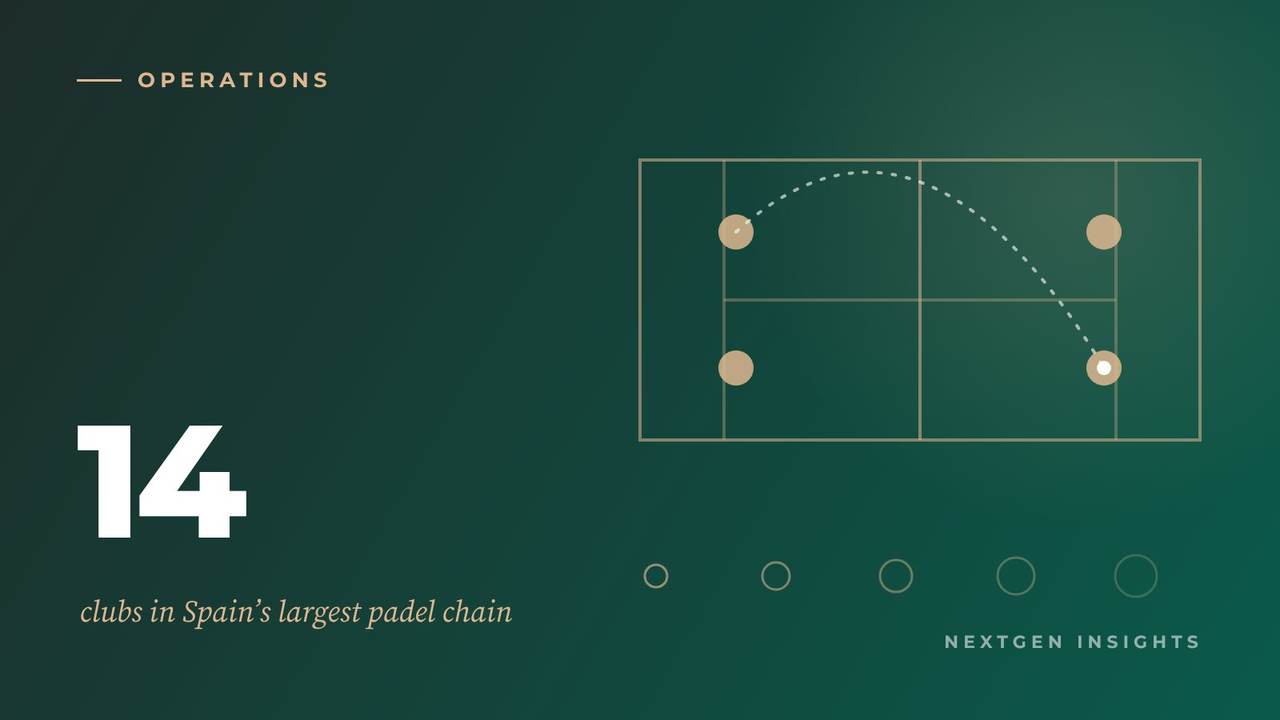
- Even in Spain, the sport’s largest market, the biggest chain runs only 14 clubs and about 255 courts. The industry is fragmented, and experienced operators are scarce.
- There are four models: self-operate, hire a general manager, contract a third-party operator or partner with a fractional executive. Each trades control, cost and speed differently.
- Decide the operating model before you finalize the design, the budget and the lease, because staffing and layout depend on it.
Many owners spend months on the site and the courts and weeks on the question that will matter most after opening: who will run the club? A padel club is a hospitality-and-sport business that runs 14 hours a day, seven days a week, with customers who judge it at every visit. This article compares the four main operating models and how to choose among them.
Why operations decide outcomes
Playtomic’s 2026 Global Padel Report finds that top-performing clubs earn about €3,531 per court per month in booking revenue against €736 for bottom performers, roughly five times more, within the same markets. The seven drivers it lists (courts per club, games per court per month, price per hour, online booking share, indoor share, open-match share and academy and competition share) are operating choices. Playtomic also notes that Spain’s largest chain operates only 14 clubs and about 255 courts. In a fragmented industry, no scale player has yet captured operating know-how, so the difference between a great club and a poor one is largely the team running it.
Source: Playtomic–Strategy& (PwC) Global Padel Report 2026, as summarized by PADEL1969. About 5× within the same markets.
Four operating models
| Model | How it works | Pros | Cons |
|---|---|---|---|
| 1. Owner-operated | The owner or a partner runs the club day to day | Full control, aligned incentives, no management fee | Needs real operating experience and time; key-person risk; hard to scale |
| 2. Hired general manager | The owner employs a GM and team and supervises | Control with delegation; builds an in-house team | Hiring quality is critical; owner must manage and set KPIs; learning-curve cost |
| 3. Third-party operator | An experienced operator runs the club under a management or lease agreement (fee, profit share or both) | Experience and systems from day one; faster ramp-up; owner stays passive | Fees and profit share; less control; contract and exit terms matter; operators are few |
| 4. Fractional executive support | A part-time senior operator (such as a fractional COO) sets up systems, hires and coaches the team, then stays on a limited basis | Senior expertise at a fraction of full-time cost; transfers know-how to your team | Requires an internal team to execute; availability limited by design |
The fourth model is increasingly common because it sits between self-operation and full outsourcing. See our guide on fractional COOs.
A decision framework
1. Assess the owner’s capacity honestly
Does the owner have experience running a service business with front-of-house teams, bookings, coaching staff and a community? Can they be on site or reachable at peak times for the first year? If not, delegate.
2. Consider the scale of the plan
A single club may support a GM and a small team. A portfolio of clubs requires systems, standard operating procedures and regional management. Third-party operators and fractional executives are valuable when a platform is being built, because they create the playbook.
3. Match the model to the concept
A court-only club with online booking and a lean team differs from a destination venue with F&B, wellness and events. The more hospitality in the model, the more specialized the operator needs to be.
4. Weigh cost against ramp-up risk
Management fees reduce margins, but a slow ramp-up is more expensive. The cost of three extra months to reach target utilization can exceed a year of fees. Model both.
What to look for in an operator or GM
- Track record: clubs run, utilization achieved, retention, reviews and references from owners.
- Commercial skill: pricing, membership design, partnerships and events, not only service.
- Community builder: evidence they can build leagues, ladders and a coaching program.
- Systems: booking platform proficiency, reporting discipline and standard procedures.
- People management: hiring, training and retaining coaches and front-of-house staff.
- Financial literacy: budgets, cost control and cash management.
Structuring a management agreement
| Term | What to negotiate |
|---|---|
| Alcance | Pre-opening services, staffing, marketing, procurement, reporting and who bears each cost. |
| Fees | Base fee, percentage of revenue, incentive on profit or on KPIs. Avoid structures that reward revenue growth at the expense of margin. |
| KPIs | Utilization, revenue per court hour, retention, customer satisfaction and cost ratios, reported monthly. |
| Authority | Spending limits, hiring authority, pricing decisions and approvals reserved to the owner. |
| Term and exit | Initial period, renewal, termination for cause and without cause, transition support and ownership of data and brand. |
| Non-compete and key people | Protection for the owner if the operator leaves or opens a competitor nearby. |
Governance: how owners keep control without micromanaging
- Agree a budget and annual plan with targets.
- Hold a monthly review of a short dashboard: utilization, revenue per court hour, membership numbers, labor cost ratio and customer feedback.
- Define decision rights in writing, including what requires owner approval.
- Keep ownership of customer data, booking accounts and social channels.
- Use an independent review once a year to benchmark performance.
NextGen’s operating experience
NextGen’s team has direct operating involvement in live U.S. padel facilities, and our owner representation, club operations consulting and fractional COO services are designed to help owners choose the right model and set clubs up to run well. We recommend what we would do ourselves.
Fuentes
- PADEL1969: Global Padel Report 2026 summary (Playtomic–Strategy&; top vs. bottom club revenue; performance drivers; Spain’s largest chain).
The comparison of operating models and the agreement checklist are our professional guidance, not published benchmarks.