
Ideas clave
- Europe has more than 45,000 padel courts and 18 million players (FIP, October 2025). Spain alone reported about 17,000 courts and 109,040 federated players at the end of 2024.
- Playtomic sorts markets into archetypes: Heartlands, Sweet Spot, Hotspot, Diamonds in the Rough and Post-Boom. The U.S. is a Diamond in the Rough; Sweden, Finland and Chile are Post-Boom.
- Europe’s lessons are mixed: padel can become mainstream, but supply can outrun demand, and the unit economics that work in Madrid do not transfer automatically to Miami.
- U.S. clubs are structurally different: higher prices, higher rents, imported equipment and thinner player density.
Padel is not new. It was invented in Mexico in 1969 and spread through Spain and Argentina, where it is a mass sport. Today Europe is the sport’s center of gravity, and U.S. investors often point to Europe as proof of what is possible. That is half right. Europe shows what padel can become, and also what can go wrong. This article distills the lessons.
Europe in numbers
The FIP’s research department reported in October 2025 that Europe has more than 45,000 padel courts (about 65% of a global total it puts above 70,000), 18 million players and more than 14,000 clubs, up from roughly 5,000 clubs at the start of 2020. Padel is present in all 50 European countries. Playtomic and PwC’s Strategy& count a lower global total (58,300 courts and 19.4 million players at the end of 2025) because the organizations use different definitions. A third estimate, 35 million players worldwide, circulates widely but has no named source. When you see padel statistics, check who counted and how.
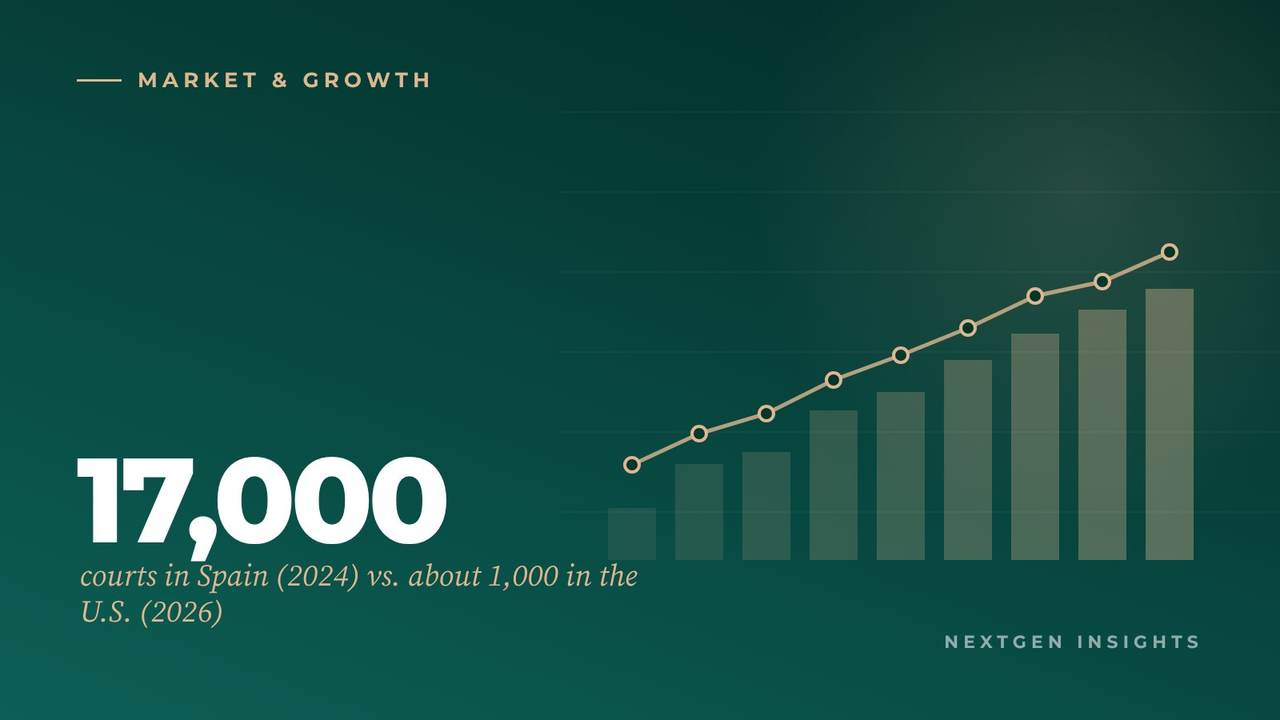
Spain gives the clearest picture of maturity. At the end of 2024 the Spanish federation reported almost 4,500 clubs and facilities with about 17,000 courts (up 5% on the year), roughly one court per 2,800 people. It issued 109,040 federated player licenses in 2024, up 8% from 2023 and 175% since 2012; about 36% of licenses are held by women. A separate survey estimated that 12.7% of Spain’s population, more than six million people, play.
Source: Real Federación Española de Pádel, reported by FIP (February 2025). Licenses cover federated players only; far more people play recreationally.
Five archetypes of padel markets
Playtomic’s 2026 report classifies markets by maturity and density:
| Archetype | Examples | Characteristics |
|---|---|---|
| Heartlands | Spain, Italy, Portugal, Argentina | Largest installed base and long tradition. Spain’s largest chain operates only 14 clubs and about 255 courts, so the market is fragmented. About 2% of Spanish courts are in residential developments. |
| Sweet Spot | Netherlands, Belgium, France, Switzerland, South Africa | Density of roughly 5–19 courts per 100,000 people, average growth about 23%. France added the largest share of new courts globally in 2025 (1,142). |
| Hotspot | UK, Germany, Ireland | Demand outpaces supply, density about 2–12 courts per 100,000, average growth around 30%. The UK shows 86% CAGR since 2021, about 85% average peak occupancy and about half of players struggling to book at peak. |
| Diamonds in the Rough | U.S., India, Australia, Indonesia, Brazil, Poland | Density about 0–1 court per 100,000. Early stage with major upside and structural barriers. |
| Post-Boom | Sweden, Finland, Chile | Density about 12–33 courts per 100,000, growth around 1% and sometimes negative. Finland’s commercial clubs show peak utilization of about 41%. |
What the U.S. can learn
1. Mainstream status is possible, but it takes time
Spain’s padel culture took decades to build. U.S. growth is faster from a lower base, but community, coaches, competition and media take time to develop. Plan for a multi-year ramp-up and for the cost of educating the market.
2. Density creates both opportunity and risk
The U.S. has about 1,000 courts for roughly 340 million people, about one court per 340,000 people (our arithmetic), versus about one per 2,800 in Spain. The headroom is enormous. But Chile shows the risk of fast overbuild: clubs rose from 148 to 198 between 2022 and 2023 and courts from 570 to 788; later, reservations at major operators fell sharply and over 80 clubs closed, leaving the country with 620-plus clubs and about 2,300 courts. The lesson is local: if your catchment adds ten courts, it does not matter that the nation has few.
3. Fragmentation rewards operating excellence
In the most mature market, no operator dominates: Spain’s largest chain has 14 clubs. Differences between clubs matter more than differences between brands. Within the same markets, Playtomic finds top clubs earn about five times the booking revenue per court of bottom clubs. Management quality is the moat.
4. Business models diverge by region
European clubs often rely on high volume at lower prices. U.S. clubs face higher rents, higher construction and import costs and fewer players per court, so they price higher: Playtomic reports a U.S. average of about €92 (roughly $100) per booking session, the highest of any country it tracks. U.S. clubs also show higher adoption of add-ons such as video and ball machines. Replicating a European low-price, high-volume model in the U.S. is likely to fail on unit economics; replicating a premium model without a premium customer base is as risky.
5. Real estate integration is a European strength
European developments increasingly pair padel with real estate: Playtomic cites Quinta do Lago in Portugal (about 30% residential value appreciation and owner retention above 75%, partly attributed to its padel-anchored masterplan), a €100 million sports and leisure real estate vehicle in Marbella and an €800 million Madrid sports development with 24 padel courts. Those are the report’s claims and should be tested in each case, but they show the direction of travel. See our article on resorts and mixed-use.
6. Federations and competition matter
Spain’s federation counts more than 1,500 federated clubs and 1,400 coach licenses, an infrastructure that supports player development. In the U.S., the USPA reports club membership growth of 51.5% in 2025 and a tournament calendar that went from 104 sanctioned open events in 2025 to 255 scheduled for 2026. Aligning with the federation structure early builds credibility.
What does not transfer
- Cost structure. Courts are typically manufactured in Europe and imported, and U.S. commercial rents and labor costs differ.
- Customer habits. European players often walk or drive short distances to neighborhood clubs; many U.S. catchments are larger and car-dependent.
- Regulation. Zoning, permitting and liability regimes differ by state and city.
- Marca. A European club’s brand does not travel automatically; U.S. players may not know it.
How NextGen uses this experience
NextGen operates across both continents, with projects such as Padel Sense in Madrid and Austin Padel Center in Texas, and affiliates in Spain. That vantage point lets us ask, for each U.S. project, which European lessons apply and which do not. Our U.S. market entry advisory helps European operators and investors adapt their models for American markets.
Fuentes
- FIP: Europe as queen, 18 million players and 45,000 courts (October 2025).
- FIP: Padel in Spain, growth in courts and player licenses in 2024.
- PADEL1969: Global Padel Report 2026 summary (archetypes, Chile, real estate deals).
- Padel Business Magazine: Playtomic report highlights real estate, wellness and global investment shifts.
- Club + Resort Business: Playtomic 2026 Global Padel Report.
- Padel Browser: Padel growth in the United States, 2026.
- The Padel Paper: USA reaches 1,000 padel courts.
- USPA: Padel surpasses one million players.
Global court and player totals differ between FIP and Playtomic because of different definitions.