
Ideias-chave
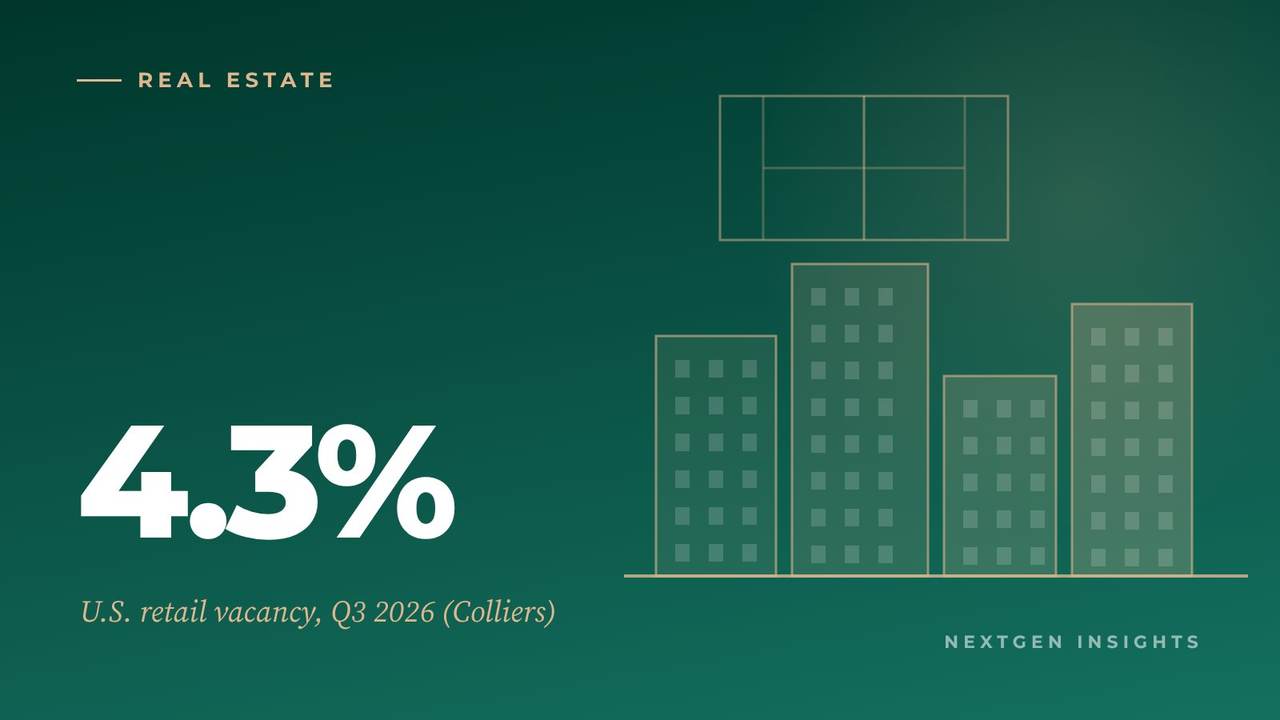
- U.S. retail is tight: Colliers reports a 4.3% national vacancy rate in Q3 2026, near record lows, with asking rents of about $26.20 per square foot. The “empty box” story of 2023 is less true today, so sports tenants compete with retailers for space.
- Racquet-sports tenants still bring landlords what many retailers do not: repeat visits, long dwell times, evening and weekend traffic and cross-shopping. Landlords and mall owners are courting them as experiential anchors.
- Examples show the scale: a former Belk anchor in Macon, Georgia became a 32-court pickleball venue; a 104,000 sq ft anchor at Arizona Mills in Tempe became a 24-court facility.
- Different property types suit different formats. Indoor padel needs clear height of about 7 meters and strong power, which points to industrial, flex and big-box buildings more than to in-line retail.
For decades, commercial landlords filled space with retailers, restaurants and offices. The rise of experiential tenants, fitness, entertainment and now racquet sports, has added a new category: the sports anchor. For developers and owners, a well-run padel or pickleball club can turn a hard-to-lease building into a destination. For operators, real estate is both the biggest cost and the biggest lever. This article looks at the opportunity from both sides.
The market backdrop
Colliers’ Q3 2026 report, as covered by CRE Daily, shows a retail market that is tighter than many assume: national vacancy of 4.3% (down 10 basis points on the quarter), net absorption of 10.5 million square feet (the strongest since 2023), leasing of 38.4 million square feet and average asking rent of $26.20 per square foot, up 0.7% from Q2. About 58.1 million square feet was under construction, with the largest pipelines in Dallas–Fort Worth (7.2 million sq ft), Houston (5.1 million) and Austin (3.2 million).
Sources: Colliers via CRE Daily (retail); Cushman & Wakefield Q3 2026 U.S. MarketBeat (multifamily). Different firms use different methodologies.
What this means: unlike in 2023, when closures of chains left many large boxes vacant and trade press highlighted conversions to pickleball, space today is often contested. Racquet operators must show landlords they are credit-worthy, can pay market rent and bring value beyond filling a vacancy. Some sub-markets still have large second-generation boxes, but good space is not free.
Why landlords like sports tenants
- Traffic and dwell time. Players visit repeatedly, stay for an hour or more and arrive in groups, in evenings and on weekends when other tenants may be quiet.
- Cross-shopping. Players eat, drink and shop nearby, supporting neighboring tenants.
- Difficult space made useful. Large, deep boxes with high ceilings and limited windows suit indoor courts better than they suit most retail.
- An experiential story. Malls and centers seeking to differentiate use sports and entertainment to pull in younger visitors. The Playtomic–Strategy& report notes padel courts are used in U.S. real estate and mixed-use developments to activate underused space and drive foot traffic.
- Institutional interest. JLL and CBRE have dedicated sports and entertainment real estate practices, and trade press reported mall owner Simon Property Group’s involvement in pickleball operator Camp Pickle’s funding.
Examples from the market
| Project | What happened | Source (date) |
|---|---|---|
| Macon Mall, Georgia | A former Belk anchor store became a 32-court indoor pickleball venue, described as one of the largest in the world. | NAR REALTOR Magazine (2023) |
| Arizona Mills, Tempe | Picklemall opened a 24-court facility in a 104,000 sq ft anchor space. | NAR REALTOR Magazine (2023) |
| Ace Pickleball Club | Targets second-generation big-box space of 25,000–50,000 sq ft holding 8–16 courts and says it can retrofit in about 100–120 days. | NAR REALTOR Magazine (2023) |
| U.S. resorts and hotels | 19 venues with padel courts, 33 courts in total; almost all small (one or two courts) and outdoor. | Padel Browser (2026) |
These are pickleball conversions, a lighter format than padel, so they show the pattern rather than the economics. Padel’s requirements are more specific.
What padel needs from a building
| Requirement | Typical need | Where it is found |
|---|---|---|
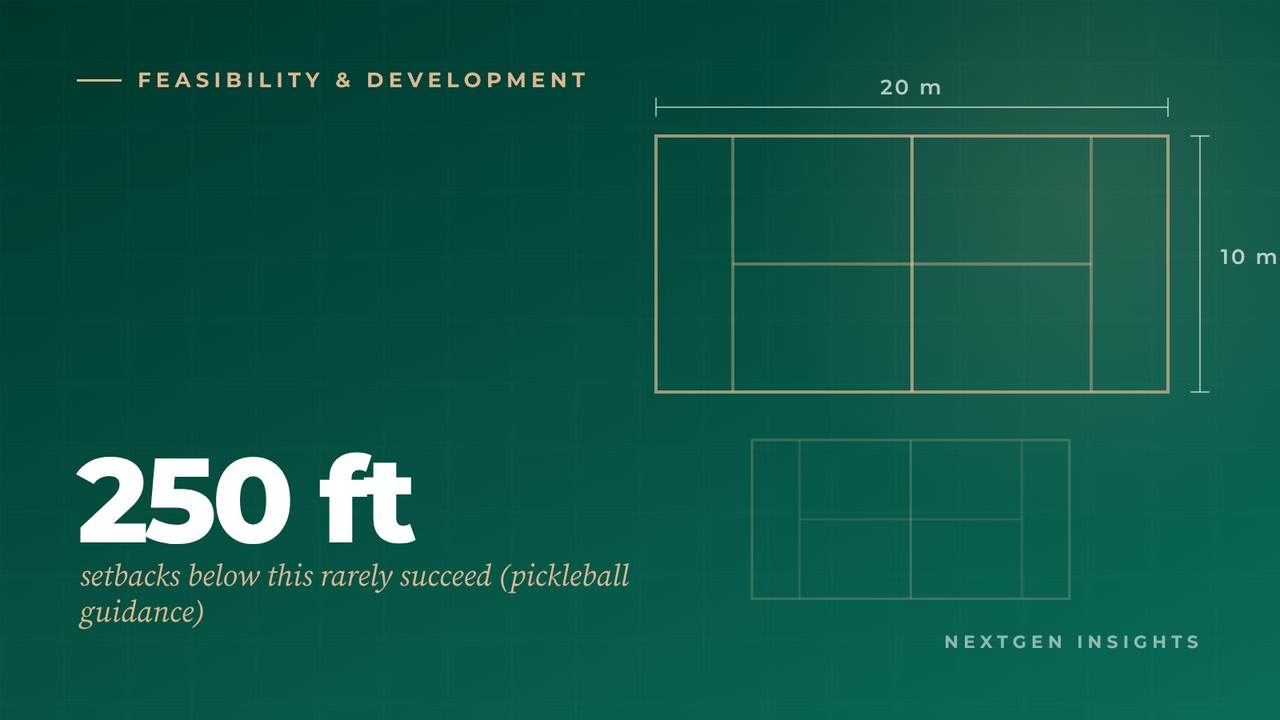
| Footprint | Courts are 10 × 20 meters, and layouts need circulation and spectator space. | Large-floorplate buildings |
| Clear height | About 7 meters (about 23 feet) above the playing surface, as cited by one guide. | Warehouses, industrial and flex, big-box retail with open roof structure |
| Column spacing | Few columns inside courts | Warehouses, some big boxes |
| Power | Lighting and HVAC loads; possible service upgrade | Industrial and large retail |
| Floor | Flat, level slab that can take the court structure | Slab-on-grade buildings |
| Parking and access | Enough spaces for peak evenings | Shopping centers, suburban industrial |
| Zoning | Permitted or conditional recreation use | Varies by municipality. See zoning guide |
Retail, industrial or ground-up?
- Big-box retail: visibility, parking and a consumer location, but tight vacancy, higher rents and sometimes restrictive lease clauses (exclusive uses, co-tenancy).
- Industrial and flex: lower rents, high ceilings and easy power, but less visibility and sometimes industrial zoning that restricts public assembly.
- Existing recreation buildings: tennis clubs, gyms or sports halls can convert efficiently, as some country clubs have done. A tennis court footprint can often fit two or three padel courts, according to one directory’s estimate.
- Ground-up construction: maximum flexibility and branding, with higher cost and longer timelines.
For landlords: how to evaluate a sports tenant
- Operator track record. Ask for operating results of existing clubs and references.
- Financial strength. Guarantees, equity and security deposit relative to the build-out.
- Plan for the building. Structural, mechanical and fire-code feasibility, and restoration at the end of the lease.
- Use compatibility. Noise, hours and parking impacts on neighbors and other tenants.
- Value to the center. Traffic patterns, amenities and effects on surrounding retail.
For operators: how to pitch a landlord
- Show the demand data for the catchment and the operator’s track record.
- Present the investment you will make (courts, fit-out) and what you need from the landlord.
- Offer a credible rent and a clear timeline, with permits as a condition.
- Explain the benefit to the property: traffic, dwell time and brand.
- Prepare for questions on noise, parking, liability and use of the space after the lease.
The next article covers lease negotiation in detail.
Our site selection and real estate advisory helps developers, landlords and operators match properties and concepts and structure deals.
Fontes
- CRE Daily: Retail vacancy falls to 4.3% as Q3 absorption hits 10.5M SF (Colliers, Q3 2026).
- NAR REALTOR Magazine: Pickleball courts serve an ace for vacant malls and retail stores (September 13, 2023).
- Padel Business Magazine: Playtomic report highlights real estate, wellness and global investment shifts.
- Club + Resort Business: Playtomic 2026 Global Padel Report.
- Padel Browser: Padel at U.S. resorts and hotels, 2026.
- Padel Browser: Why country clubs are adding padel (2026).
- Sports Venue Calculator: Padel court construction cost guide (2026) (clear height).
Retail statistics are national and vary widely by market and property type. The conversion examples are pickleball facilities reported in 2023.