
Ideas clave
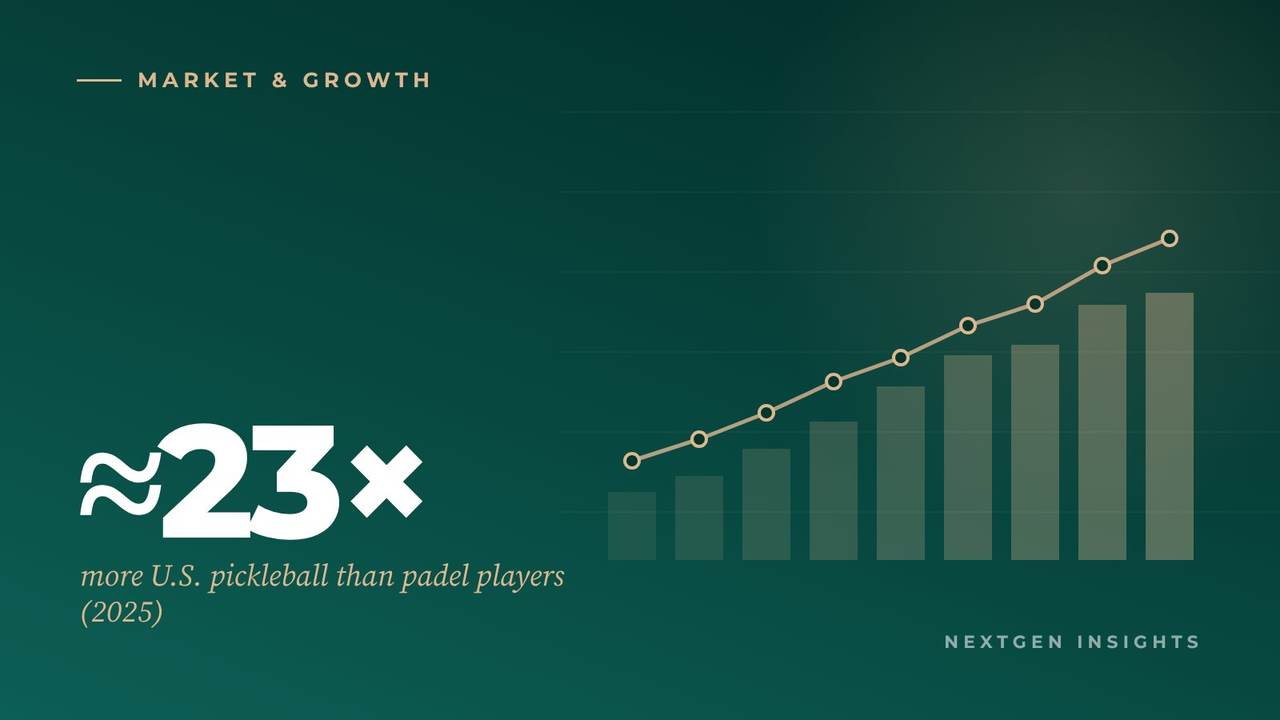
- Scale favors pickleball and tennis today: about 24.3 million pickleball players and 27.3 million tennis players in 2025, versus about 1.07 million for padel. Growth rates favor padel only because its base is tiny.
- The formats serve different business models. Pickleball is low-cost, flexible and easy to fit into existing space. Padel is higher-capital, premium-priced and more distinctive.
- Reports disagree on how fast pickleball is still growing (from roughly 1% to about 23% depending on the cut). The safe reading is that it is large and maturing.
- For many sites the best answer is a mixed or phased facility, with the sport chosen by site, capital and customer, not fashion.
Padel, pickleball and tennis are all racquet sports with social, doubles-friendly play and an expanding audience in the United States. For a developer, investor or operator they are not interchangeable. They differ in how much space they need, what they cost to build, who plays them and what a customer will pay. Choosing between them, or combining them, should be a business decision based on data.
The numbers at a glance
Sources: USTA (tennis; analysis of Physical Activity Council and PLAY Study data by the National Golf Foundation); SFIA 2026 Topline Participation Report (pickleball and padel). Methodologies differ, so compare scale, not precision.
| Tennis | Pickleball | Pádel | |
|---|---|---|---|
| U.S. participants, 2025 | 27.3 million (USTA) | 24.3 million (SFIA) | 1.073 million (SFIA) |
| Regular players | 14.5 million played 10+ times | About 7.5 million played 8+ times (as cited by DUPR’s CEO) | 238,000 played 8+ times |
| Trend | Sixth straight year of growth; +54% since 2019 | Reports disagree on 2025 growth; large and maturing | First year tracked by SFIA; USPA clubs +51.5% in 2025 |
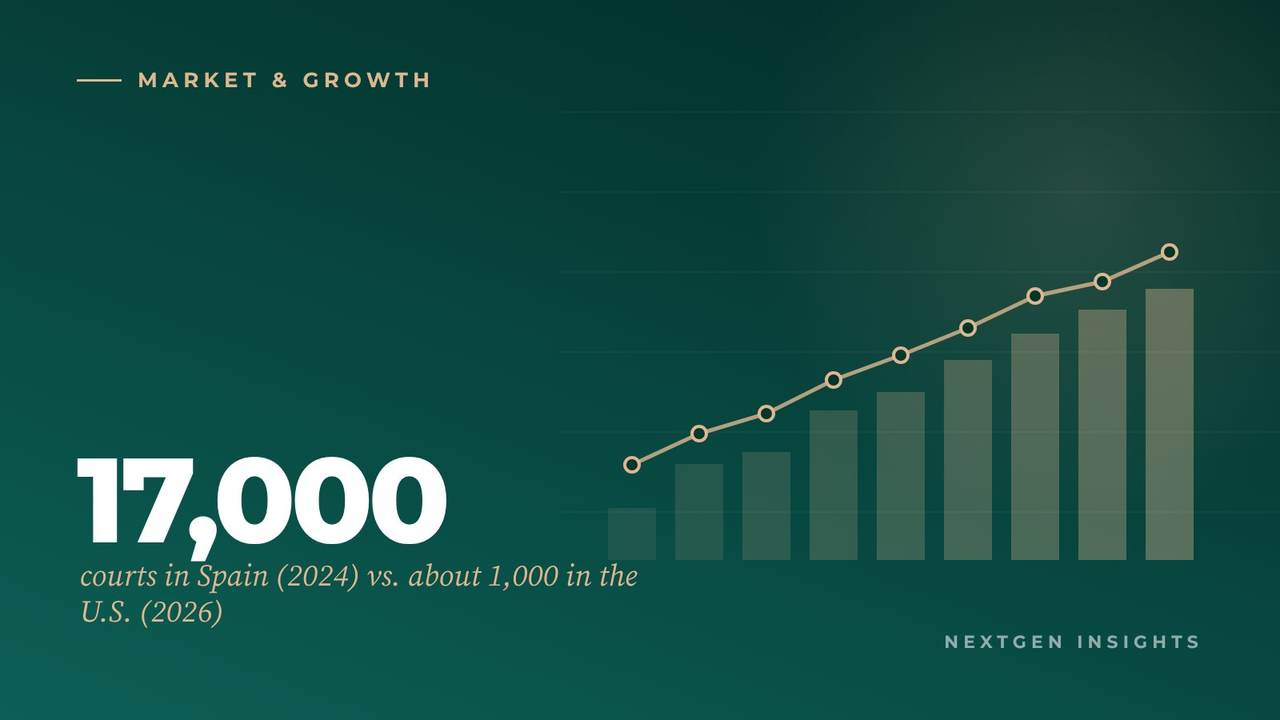
| U.S. court base | Large, mature, often under-used | Many thousands of courts and growing every month | About 1,000 courts (April 2026) |
Two cautions. First, the sources use different methodologies: the tennis figure comes from a National Golf Foundation analysis of Physical Activity Council and PLAY Study data published by the USTA, while pickleball and padel come from SFIA. Compare orders of magnitude, not decimal places. Second, SFIA tracked padel for the first time in 2025, so there is no multi-year national trend yet. Percent growth from a small base is mathematically easy: as DUPR’s CEO put it, going from one player to ten is 900% growth.
Space and construction
A pickleball court is compact: one tennis court footprint can accommodate up to four pickleball courts, which is why communities and clubs are converting tennis courts. Pickleball needs a flat, well-drained surface, a net and fencing, and can also be played indoors in large open spaces such as vacant retail boxes, where operators have retrofitted space in 100–120 days. Padel courts are 10 × 20 meters, enclosed by glass and mesh, with a specific structure, lighting and drainage; they need more planning and engineering and cost more per court. One U.S. guide puts outdoor padel courts at about $25,000–$60,000 each and indoor courts with a building at $70,000–$100,000 or more; we cover cost in our cost guide.
Audience and experience
Pickleball’s low barrier to entry and broad age range explain its explosive growth. Padel is also easy to learn but is played in an enclosed court with walls in play, a rhythm that is social, tactical and attractive to former tennis and squash players, and carries a premium image tied to hospitality, wellness and private clubs. Playtomic’s 2026 report describes pickleball as a “gateway” to padel rather than a competitor and notes padel’s premium positioning in the U.S.
How each model earns revenue
Both rely on court time, memberships, coaching, leagues and events, but they differ in price and capital intensity. Playtomic reports a U.S. average padel booking price of about €92 (roughly $100) per session, the highest of any country it tracks. Pickleball facilities typically price lower per player and aim to make it up with volume and breadth of play. Indoor pickleball concepts have also been backed by large investors: for example, trade press reported that Camp Pickle raised $200 million including capital from Simon Property Group. High construction costs are one reason operators prefer retrofitting vacant retail to building from scratch.
Risk profile
| Risk | Pickleball | Pádel |
|---|---|---|
| Competition and copyability | Lower barriers mean more competitors and easier entry | Higher capital and engineering create natural barriers |
| Noise and neighbors | Well documented: planning bodies report lawsuits, setbacks and limits on hours for outdoor courts | Less documented in the U.S. but still a zoning issue for outdoor courts |
| Market maturity | Growth moderating from a large base | Early; supply thin and uneven |
| Capital at risk | Lower per court; easier to reconfigure | Higher per court; harder to repurpose |
Combining formats
Multi-sport facilities can broaden the audience, protect against shifts in fashion and make better use of a building. Country clubs are adding padel alongside tennis and pickleball, and hotels pair it with other amenities. The complexity cost is real: different court dimensions, surfaces, lighting, scheduling and staffing. A phased plan, for example opening with pickleball or tennis conversion and adding padel as demand proves out, can reduce risk where land and permits allow.
Questions to answer before choosing
- What does the local market already offer, and which segment is underserved?
- What does the site physically allow (space, clear height, zoning, noise)?
- Who is the target customer and what will they pay per hour or per month?
- How much capital can you commit, and how much can you lose in a slow year?
- How will the facility keep players coming back after the novelty fades?
Our view
There is no universal winner. Pickleball and tennis offer scale and low cost; padel offers distinctiveness, premium pricing and a young supply base. The better sport is the one that fits your site, your market and your operating capability, and often the best answer is a combination. That is what a feasibility study is for.
Fuentes
- USPA: Padel surpasses one million players (SFIA 2026 Topline Participation Report).
- The Dink: Pickleball vs. padel, what the numbers really say about growth (September 2026; includes commentary by DUPR’s CEO).
- The Kitchen: 24.3 million Americans played pickleball in 2025.
- NBC Sports: U.S. tennis participation at a new high of 27.3 million (USTA).
- Apartments.com: Pickleball popularity soars among renters (court-footprint comparison).
- NAR REALTOR Magazine: Pickleball courts serve an ace for vacant malls and retail stores (2023; retrofit timeline, Camp Pickle funding).
- Club + Resort Business: Playtomic 2026 Global Padel Report.
- Padel Browser: How much does it cost to build a padel court? (2026).