
Ideas clave
- A feasibility study answers one question: can this club, on this site, with this budget and this operator, work? It is a decision tool with stop points, not a sales document.
- The U.S. opportunity is real (1.07 million players, about 1,000 courts) but local: Playtomic finds top clubs earn about five times the booking revenue per court of bottom clubs in the same markets.
- Work through seven stages in order: market, site, concept, capital, operating model, people and risk. Each can end the project cheaply.
- Write down your walk-away conditions before you start. If you cannot say what would change your mind, you are building a justification, not a study.
Padel is growing quickly in the United States, and that makes it easy to confuse enthusiasm with a business case. A feasibility study exists to separate the two. The goal is not to prove that a club can work somewhere; it is to find out whether this club, on this site, with this budget and this operator, can work. This is the framework we use, in the order we use it. Each stage can stop the project, and that is the point: it is much cheaper to find a problem on paper than after a lease is signed.
Stage 1: The market
Start with demand. National figures set the context: SFIA counted about 1,073,000 American padel players in 2025, of whom 238,000 played eight or more times, and racquet sports participation reached 20.6% of the population. But clubs live on local, repeat demand. Define a catchment of 10, 15 and 20 minutes’ drive time and estimate how many households match the profile of a regular player: income, age, attitude to sport and exposure to racquet sports.
Then map supply: existing padel clubs, tennis and pickleball facilities, premium fitness clubs and the pipeline of announced projects. The U.S. had about 1,000 courts in April 2026; in some catchments it has zero and in others it has more than the local market can fill. Playtomic’s report shows how fast sentiment can turn: Chile’s clubs rose from 148 to 198 between 2022 and 2023 before reservations fell and more than 80 clubs closed.
Decision point: Is there unserved, paying demand within the catchment, and can you reach it at a price the economics need?
Stage 2: The site
Padel has physical requirements many buildings and lots cannot meet. Check:
- Space and clearance. Courts are 10 × 20 meters; indoor courts need about 7 meters of clear height; allow for circulation, reception, changing rooms and growth.
- Zoning and permits. Is the use permitted, conditional or prohibited? Noise, lighting, parking and hours. See our zoning guide.
- Utilities and structure. Power for lighting and HVAC, slab condition, drainage and roof loads.
- Access and visibility. Parking for evening peaks, drive times, public transport and street presence.
- Control of the site. Lease or purchase terms, renewal options, landlord work and exclusives. See lease negotiation.
Decision point: Can the site legally and physically host the club, and can you control it on acceptable terms?
Stage 3: The concept
A club is a combination of courts, services and atmosphere. A pure court-rental model, a membership-led social club and a destination venue with F&B and wellness are three different businesses with different capital needs, risks and staffing. Decide which you are building, because every later number depends on it: the number of courts, indoor or outdoor (see formats), amenities and pricing.
Playtomic’s survey of 185 top-performing clubs shows how leaders diversify: 74% run social events, 72% instructor-led activities and 56% offer facility or wellness access. Choose additional services because they fit the market and the space, not because they are fashionable. See revenue beyond court rental.
Decision point: Is the concept differentiated, appropriate for the catchment and deliverable by the team?
Stage 4: The capital plan
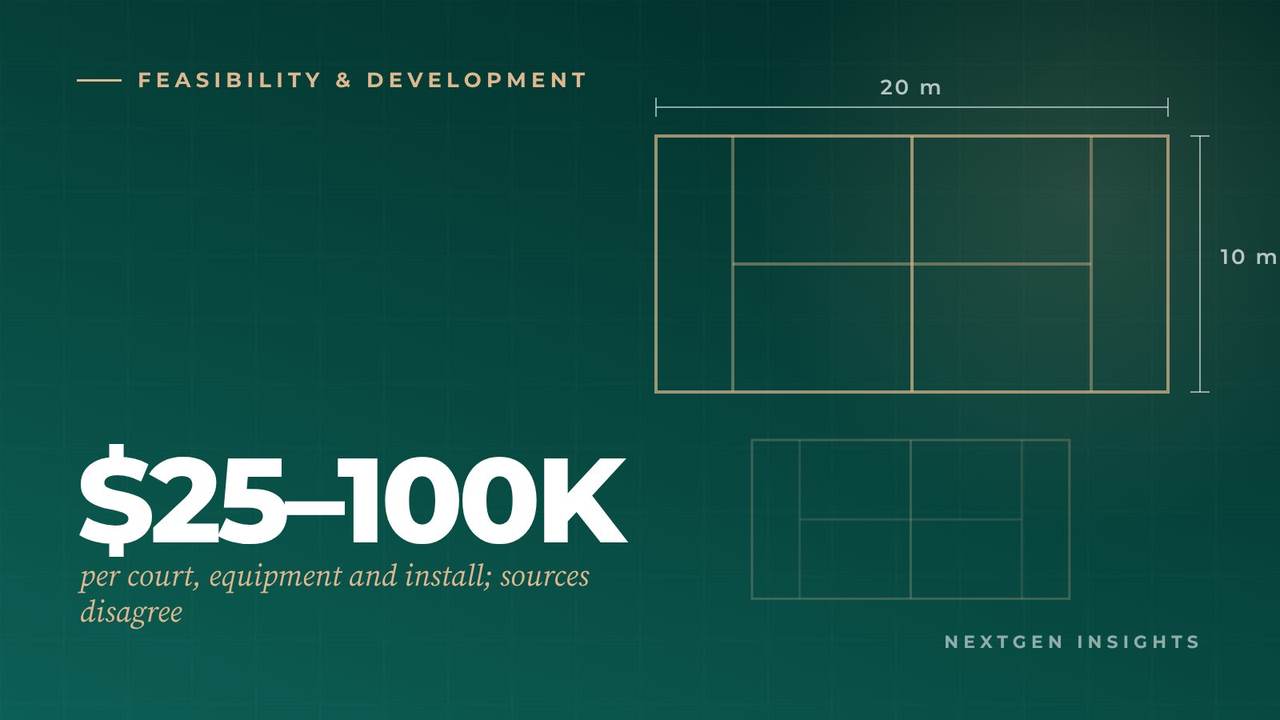
Build the budget from the bottom up. List every cost, not only the courts: site work and foundation, building shell or conversion, court systems and lighting, electrical and mechanical, reception and changing rooms, technology, design and permits, insurance, pre-opening costs, working capital and contingency. Published per-court estimates for the U.S. range widely, from about $25,000 to $100,000 for equipment and installation depending on source and scope, and indoor courts with a building can exceed that; see our cost guide.
Separate what you spend before opening from what you fund during the ramp-up. Many projects fail not because the concept was wrong, but because cash ran out before utilization matured. Then plan the funding: equity, debt (for example, SBA 7(a) or 504 programs where eligible), landlord contributions and vendor terms. See financing.
Decision point: Is there a fully funded plan that survives the downside case?
Stage 5: The operating model
Model revenue with ranges, not a single number. Court revenue depends on peak and off-peak utilization and average price per hour. Playtomic reports about 85% peak-hour occupancy for major UK clubs and about 41% for Finland’s commercial clubs, with U.S. average booking prices of about €92 (roughly $100) per session, the highest among markets it tracks. Add memberships, lessons, leagues, events, retail and F&B, and subtract rent, labor, utilities, insurance, technology, marketing and maintenance (including turf resurfacing every five to eight years).
Build three scenarios (conservative, base, optimistic) and test how long it takes to reach break-even. If the project only works in the optimistic case, it is not yet a project.
Decision point: Does the conservative case cover fixed costs and debt service within the funded runway?
Stage 6: People, programming and operations
Clubs are won on community. Who will run the club day to day? Who coaches? How will you onboard beginners, who are most of the early market (835,000 of 1.07 million U.S. players played fewer than eight times in 2025)? Plan programming, pricing, technology and a first-year calendar. Decide the operating model: owner-run, hired GM, third-party operator or fractional executive support. See operating models.
Decision point: Do you have the team and plan to deliver the experience that the model assumes?
Stage 7: Risk and walk-away conditions
| Risk | Example test | Mitigation |
|---|---|---|
| Demand | Utilization at 70% of base case | Memberships, programming, pricing flexibility |
| Cost overrun | Construction costs +20% | Fixed-price contracts, contingency, phased build |
| Delay | Permits take twice as long | Approvals contingency, rent commencement tied to permits |
| Competition | A competitor opens nearby | Differentiation, speed, community |
| Operator | Key manager leaves | Documented systems, deputy, retention incentives |
| Regulation / neighbors | Noise complaints | Acoustic design, hours, engagement |
Write down the conditions under which you would walk away: a zoning answer, a rent level, a capital requirement, a utilization threshold. Feasibility is a decision tool.
How to use the framework
- Score each of the seven stages as clear, uncertain or blocking.
- Blocking items need an answer before you spend more money.
- Uncertain items need a plan and a budget to resolve them.
- Only when the remaining questions are small should you move to design, financing and construction.
Our free feasibility checklist is a worksheet version of this framework, and our feasibility studies apply it to your site with market, site, financial and operating analysis.
Fuentes
- USPA: Padel surpasses one million players (SFIA 2026 Topline Participation Report).
- PADEL1969: Global Padel Report 2026 summary (Playtomic–Strategy&: top vs. bottom clubs, utilization, Chile, services survey).
- Padel Browser: Padel growth in the United States, 2026 (U.S. court count, average booking price).
- Padel Browser: How much does it cost to build a padel court? (2026).
- Sports Venue Calculator: Padel court construction cost guide (2026).