
Ideas clave
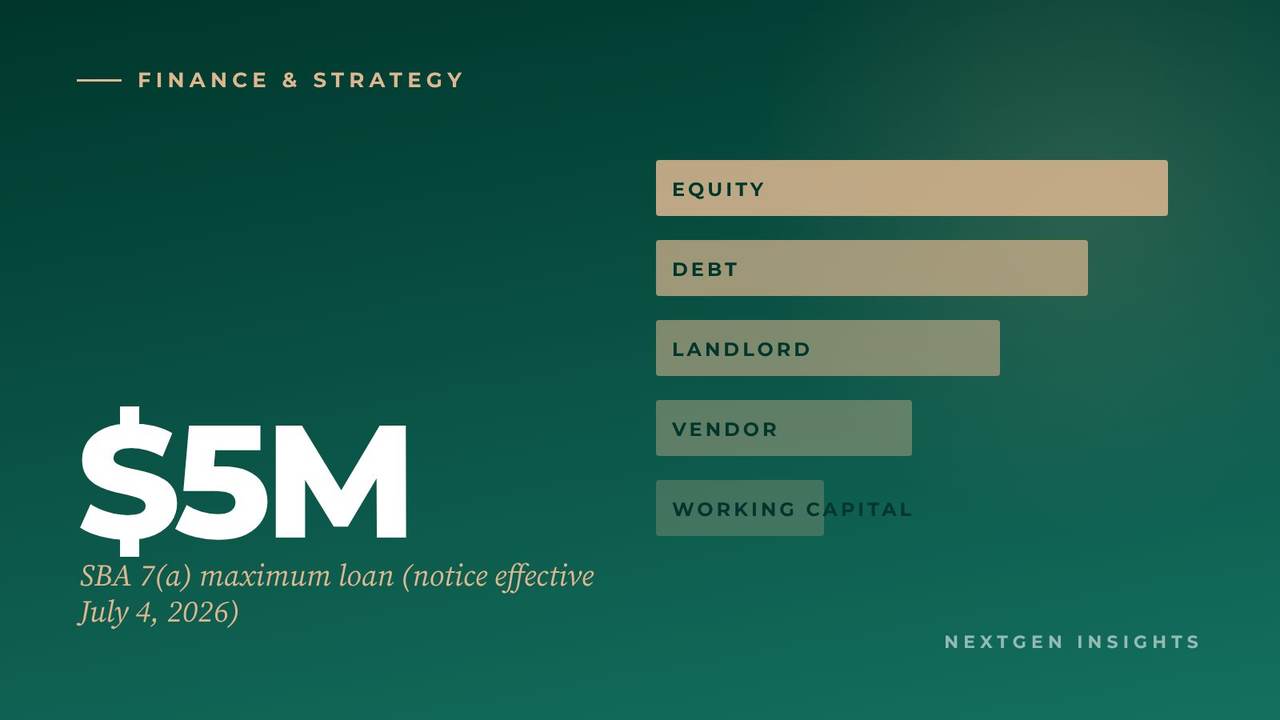
- A padel club is financed from four layers: owner equity, outside equity, debt and operating partners or vendors. Most projects use a mix.
- For debt, the SBA 7(a) program (maximum loan $5 million) and the SBA 504 program (long-term, fixed-rate financing for major fixed assets, up to about $5.5 million) are the best-known options for qualifying small businesses. SBA 7(a) maximum total guaranteed exposure per borrower is $3.75 million under the notice effective July 4, 2026.
- Lenders finance plans backed by evidence: a feasibility study, a conservative financial model, a signed or conditional lease, quotes and an experienced operator.
- Do not borrow against the optimistic case. Size debt to the downside case and keep liquidity for the ramp-up.
Opening a club requires capital before the first booking: courts, building work, soft costs, pre-opening expenses and working capital. How you fund it determines your risk, your returns and who has a say in the business. This guide explains the main sources and what each one expects. It is educational, not financial advice, and loan programs and rates change; verify terms with your lender.
The capital stack
| Layer | Typical sources | What they want |
|---|---|---|
| Owner equity | Founders’ savings, family and friends | Alignment and control. Lenders look for meaningful owner investment. |
| Outside equity | Private investors, family offices, real estate sponsors, strategic partners | Return on investment, governance rights, exit path. Often attracted by real estate or portfolio plans. |
| Debt | Banks, SBA-guaranteed loans, equipment finance, landlord contributions | Repayment capacity, collateral, guarantees, covenants. |
| Vendor and partner financing | Court suppliers, landlords (tenant-improvement allowances), sponsors | Volume, long-term relationship, brand exposure. |
SBA-backed loans
The U.S. Small Business Administration guarantees loans made by banks and other lenders to qualifying small businesses, which makes lenders more willing to finance start-ups and long-term assets. Two programs are most relevant to clubs.
SBA 7(a)
The 7(a) program is the SBA’s most general loan. A May 18, 2026 SBA policy notice, effective for loans receiving an SBA loan number on or after July 4, 2026, clarified that the maximum 7(a) loan is $5 million and that total SBA-guaranteed exposure per borrower, including affiliates and across SBA programs, is capped at $3.75 million ($4.75 million for a qualifying export loan). The notice distinguishes these limits from pending legislation that could raise the maximum 7(a) loan to $10 million, which has not been enacted as of this writing; check with your lender before relying on any change. Uses typically include equipment, leasehold improvements, working capital and business acquisition. For a club in a leased space, 7(a) can fund court systems, fit-out and some working capital.
SBA 504
The 504 program provides long-term, fixed-rate financing for major fixed assets through a Certified Development Company (CDC) working alongside a senior lender. The SBA’s page describes a maximum of $5.5 million in its main text (its summary says “up to $5 million”, so confirm the current figure), repayment terms of 10, 20 or 25 years, and a rate pegged to an increment above the 10-year U.S. Treasury rate. Eligible uses include purchase, construction or renovation of land and buildings and long-term machinery and equipment with at least 10 years of remaining life. Working capital, inventory and speculative investment in rental real estate are not eligible. A 504 loan suits a club owner who buys or builds the building and occupies it, more than a club that leases.
The notice also confirms that a borrower can sequence the two: a lender can approve a 7(a) loan first and the CDC a 504 transaction second, subject to the program limits.
Equipment finance and vendor terms
Court systems, lighting and fit-out equipment can be financed or leased against the equipment itself, which preserves cash. Compare total cost, term versus the 20–25-year expected court life and turf resurfacing needs (typically every 5–8 years), and ensure that the lender’s collateral requirements fit the entity structure. Court suppliers sometimes offer payment milestones tied to production, shipping and installation; negotiate them carefully because courts are typically manufactured in Europe and shipped to the U.S.
Landlord contributions
A tenant-improvement allowance, free-rent period or landlord-built shell can reduce your upfront capital. Landlords see sports tenants as a way to fill space and bring traffic. Some retail owners have embraced pickleball and other experiential concepts for that reason. In exchange, landlords ask for longer terms, stronger guarantees or higher rent. See lease negotiation and clubs as anchor tenants.
Outside equity
Investors in sports clubs range from local business owners to real estate sponsors and funds. The Playtomic report notes that institutional funds, developers and family offices are deploying capital into padel-backed projects and cites deals such as a €100 million sports and leisure real estate vehicle in Marbella. The Pro Padel League’s $15 million Series A in March 2026, on top of a $10 million seed round in March 2025, shows investor appetite at the league level. For a club, outside equity is most credible when it comes with an experienced operator, a replicable concept and a real estate angle.
Raising money from investors triggers securities-law obligations; use counsel.
What lenders and investors will ask for
- A feasibility study with demand, supply and site analysis.
- A business plan and financial model with a conservative case, monthly cash flow through ramp-up and sensitivity analysis. See business plans and financial modeling.
- A budget with firm quotes, contingency and working capital. See our cost guide.
- A lease or purchase agreement with approvals as conditions.
- Management credentials: who runs the club and what experience they have.
- Entity structure and guarantees that match the capital structure.
- Insurance and permits in progress.
Sizing debt sensibly
Because padel ramp-ups vary (Playtomic’s data show top clubs earning about five times the booking revenue per court of bottom clubs), debt service should be covered under the conservative case, not the base case. Practical rules: keep a cash reserve covering several months of fixed costs; match the loan term to the useful life of the asset; avoid personal guarantees you do not understand; and avoid covenants that bite in a slow first year.
A funding plan, step by step
- Build the budget and the downside case.
- Decide the target mix of equity, debt and landlord or vendor contributions.
- Prepare the lender and investor package.
- Approach lenders and investors with a clear request and use of funds.
- Negotiate terms alongside the lease so that timing and conditions align.
- Reserve working capital for the ramp-up.
Our investment advisory and financial modeling services prepare projects for lenders and investors.
Fuentes
- NAGGL: SBA policy notice clarifying maximum loan limits for 7(a) and 504 (notice dated May 18, 2026; effective July 4, 2026).
- U.S. Small Business Administration: 504 loans.
- PADEL1969: Global Padel Report 2026 summary (investment trends; top vs. bottom club revenue).
- NSGA: Pro Padel League announces Series A.
- Padel Browser: How much does it cost to build a padel court? (2026) (turf resurfacing and court life).
SBA program rules, limits and rates change; confirm with an SBA lender or CDC. Educational content only; not financial or investment advice.