
Ideas clave
- With U.S. multifamily vacancy at 8.6% in Q3 2026 (Cushman & Wakefield), owners are competing for renters, and amenities are part of that competition.
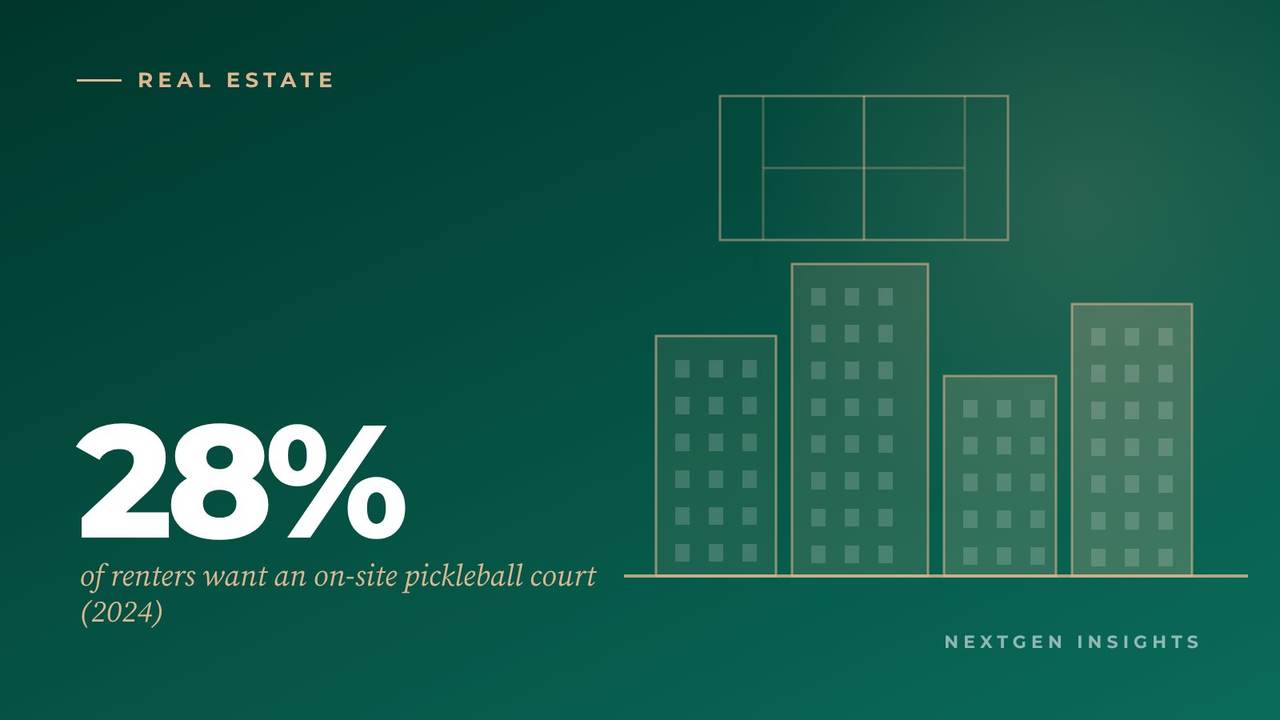
- Renter interest in an on-site pickleball court rose from 22% to 28%, and renters said they would pay about $57 more per month for access, in a 2024 NMHC/Grace Hill survey as reported by Apartments.com. A listing platform has a commercial interest in the topic, so treat the figure as directional.
- Amenities do not automatically raise rents. The same resident data show that some popular amenities, such as pools, are associated with rent discounts in regression models, while others correlate with higher rent.
- Padel is a heavier lift than pickleball (more space, higher cost, more noise exposure), but suits premium, lifestyle-oriented and mixed-use communities where a sports club can also serve non-residents.
For a multifamily developer or owner, the question is not whether racquet sports are popular, but whether a court makes an apartment community more leasable, more profitable or more valuable. The honest answer is: sometimes. This article looks at the market backdrop, the evidence on amenities and a practical framework for deciding whether to add pickleball or padel to a residential project.
The market backdrop: supply is easing but vacancy is elevated
Cushman & Wakefield’s Q3 2026 U.S. Multifamily MarketBeat reports a national vacancy rate of 8.6%, down 30 basis points on the quarter and more than 90 basis points below the Q4 2025 peak. Average asking rent was $1,950 a month, up 2.3% year on year (from 1.1% growth in Q1 2026). Net absorption reached nearly 350,000 units year to date, up 14% year on year, while completions fell to about 250,000 units (from 335,000 a year earlier). Fewer than 480,000 units were under construction, 3.6% of existing inventory and the lowest nominal level since 2015. Three of the top five markets by absorption were in Texas: Dallas–Fort Worth (more than 50,000 units), Austin (34,000) and Houston (26,000).
The picture: demand is recovering and new supply is receding, but vacancy remains well above the lows of recent years. Owners and lenders are therefore sensitive to anything that improves lease-up speed, retention and brand.
What renters say they want
Apartments.com, citing the 2024 NMHC/Grace Hill Renter Preferences Survey, reports that 28% of renters are interested in an on-site pickleball court (up from 22% two years earlier) and that they would pay about $57 more per month for access. It also reports that apartment listings with a pickleball court on its platform grew more than sevenfold since 2021. These are marketing-oriented claims from a platform that sells listing advertising, and the article gives no cost or maintenance figures.
Source: Apartments.com, citing the 2024 NMHC / Grace Hill Renter Preferences Survey. The same source reports renters would pay about $57 more per month for access. A listing platform has a commercial interest in the topic.
The Grace Hill Q4 2024 Resident and Tenant Amenities Report adds a more cautious lens. It found that the fitness center was among the top three amenities for resident satisfaction, that pools had high satisfaction but were associated with a rent discount in its regression model, and that some less glamorous amenities, such as bike storage, were among those most correlated with higher monthly rent. The lesson is that amenities are not interchangeable: some retain residents, some justify rent and some are simply the cost of being competitive.
Pickleball: the low-cost option
Pickleball needs less space than tennis: one tennis court footprint can accommodate up to four pickleball courts, which is why communities with underused tennis courts are converting them. It can be built with a surface, net and fencing at relatively low cost compared with padel. Its drawback is noise: planning authorities have responded to complaints and lawsuits with setbacks, hours limits and conditional-use rules (see our zoning guide). In a residential community, a court close to apartments is a source of complaints; location and acoustic design matter more than the number of courts.
Padel: the premium, higher-capital option
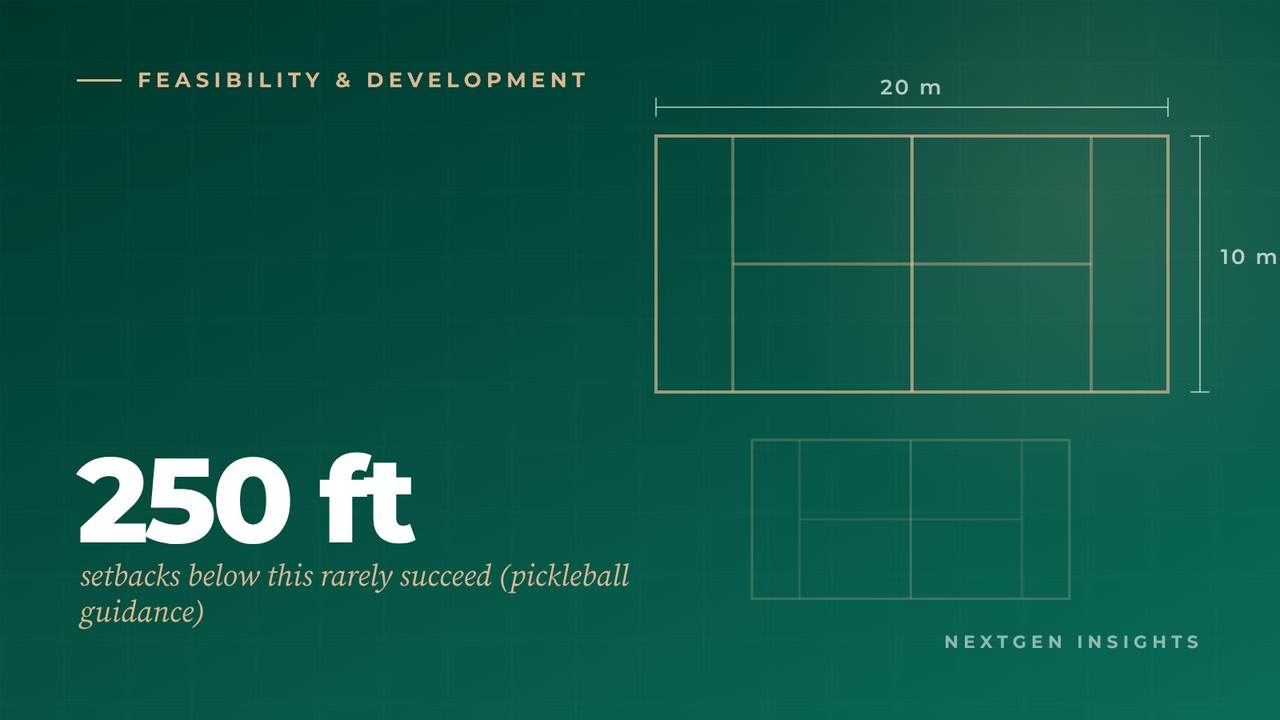
Padel courts are enclosed by glass and mesh, 10 × 20 meters each, and typically cost more than pickleball courts. One U.S. guide puts outdoor padel at about $25,000–$60,000 per court and indoor at $70,000–$100,000 or more including a building (see our cost guide). The Playtomic–Strategy& report says padel courts are becoming standard amenities in residential, hospitality and mixed-use developments, and cites Quinta do Lago in Portugal, where it reports about 30% residential value appreciation and owner retention above 75%, partly attributed to a padel-anchored masterplan. Those are the report’s claims about one resort community, not a U.S. multifamily benchmark, and in Spain only about 2% of courts sit in residential developments. Treat the effect as plausible and to be tested, not as a rule.
Decision framework for developers and owners
| Question | If yes | If no |
|---|---|---|
| Is your target renter young, active and affluent, in a market where racquet sports are popular? | A court can differentiate the community and support retention | The money may be better spent on other amenities |
| Is there space away from bedrooms and neighbors? | Outdoor courts are feasible | Consider indoor courts, a rooftop with acoustic design or no courts |
| Can the court serve more than residents (members, guests, leagues)? | A sports club can generate revenue and community, especially padel | The court is a pure amenity; keep cost low |
| Do you have an operator or a plan for maintenance, booking and programming? | Utilization will be higher and complaints lower | An unmanaged court risks being under-used or a nuisance |
| Does the pro forma work without a rent premium? | The amenity is justified by retention and lease-up speed | Do not underwrite a premium you cannot demonstrate |
Three models
- Resident amenity. One or two courts, included in rent, simple booking. Low operating cost, benefit through retention and marketing.
- Operated club in a mixed-use development. Several courts operated by a specialist, with memberships open to residents and the public, adding foot traffic and an on-site F&B anchor. Higher capital, more complex, potentially a revenue line.
- Ground lease or partnership. An operator builds and runs a club on part of the site under a long-term lease, sharing upside with the owner.
How to test the idea before building
- Survey current and prospective residents about interest and willingness to pay.
- Check competitors’ amenity sets and what they charge.
- Run a pro forma with and without a rent premium and with conservative lease-up assumptions.
- Engage acoustic and zoning consultants early.
- Pilot with temporary or lower-cost courts where possible.
NextGen’s sports facility development advisory helps developers decide whether, where and how to integrate racquet sports into residential and mixed-use projects, and our feasibility studies test the numbers.
Fuentes
- Cushman & Wakefield: Q3 2026 U.S. Multifamily MarketBeat (published October 8, 2026).
- Apartments.com: Pickleball popularity soars among renters (August 2024; citing the NMHC/Grace Hill Renter Preferences Survey).
- Grace Hill: Q4 2024 Resident and Tenant Amenities Report.
- Padel Business Magazine: Playtomic report highlights real estate, wellness and global investment shifts.
- PADEL1969: Global Padel Report 2026 summary (share of Spanish courts in residential developments).
- Padel Browser: How much does it cost to build a padel court? (2026).
The survey percentages come from a listing platform’s summary of the NMHC/Grace Hill survey and could not be checked against the full report. No source we found quantifies a rent premium specifically for padel in U.S. multifamily.